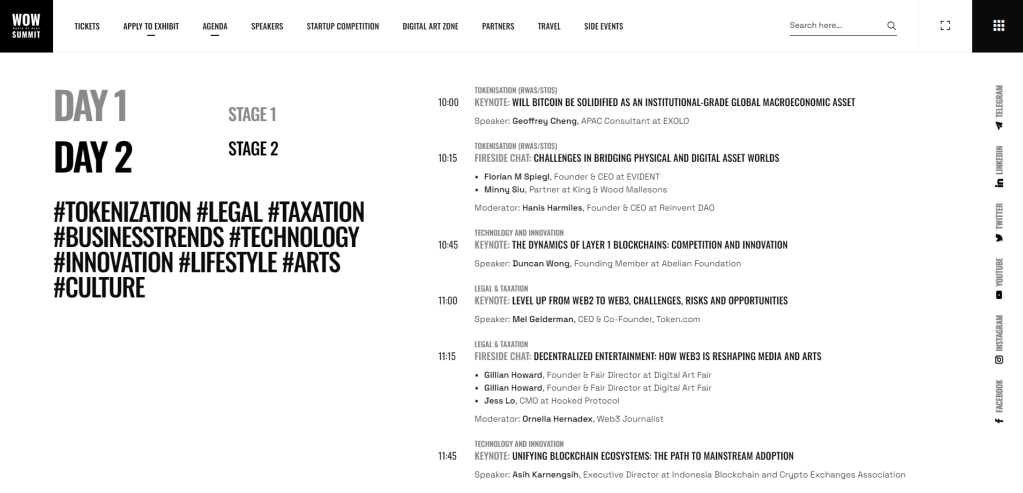
The keynote address is titled “The Future of Bitcoin – Institutionalization as a Global Macroeconomic Asset” – WATCH HERE
In the realm of global finance, few assets have captured the world’s attention quite like Bitcoin. Initially met with scepticism, it has evolved from a fringe concept into a top 10 global asset by market cap.
On March 26-27, join me at AsiaWorld-Expo as we explore Bitcoin’s potential as an institutional-grade global asset.
Use the promo code WOWHK24SPEAKER to access a 20% discount on your ticket. See you there at WOW Summit!
We also surveyed some crypto enthusiasts in this video, who tried out Animoca titles incl. @TheSandboxGame and shared their reservations about blockchain games going mainstream https://t.co/lwZ7DRSJAo
“Why is our metaverse better than Facebook’s? To me, this is not even a question.” Gaming giant Animoca Brands has hit $6 billion valuation after a round of funding this year. And it’s betting on blockchain as the next evolution in the industry. (Source: Bloomberg)
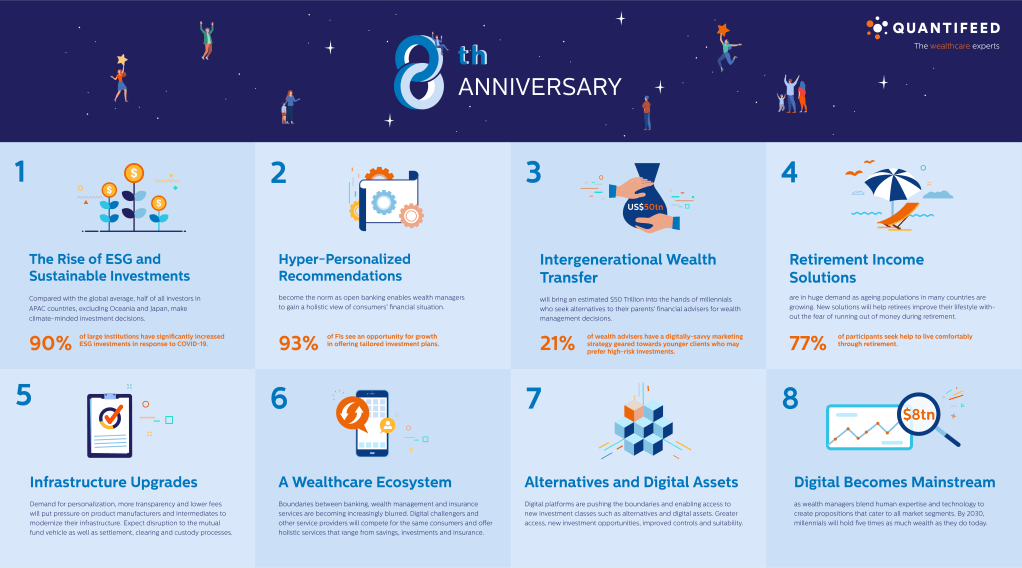
It’s Quantifeed’s 8th anniversary! At Quantifeed. we are helping financial institutions provide sustainable, transparent, and affordable wealth management to everyone. As we celebrate our eighth anniversary, we share eight trends that are shaping digital wealth management.
1. The Rise of ESG and Sustainable Investments
Compared with the global average, half of all investors in APAC countries, excluding Oceania and Japan, make climate-minded investments decisions.
90% of large institutions have significantly increased ESG investments in response to COVID-19.
2. Hyper-Personalized Recommendations
Hyper-personalized recommendations become the norm as open banking enables wealth managers to gain a holistic view of consumers’ financial situations.
93% of FIs see an opportunity for growth in offering tailored investment plans.
3. Intergenerational Wealth Transfer
Intergenerational wealth transfer will bring an estimated $50 Trillion into the hands of millennials who seek alternatives to their parents’ financial advisers for wealth management decisions.
21% of wealth advisers have a digitally-savvy marketing strategy geared towards younger clients who may prefer high-risk investments.
4. Retirement Income Solutions
Retirement income solutions are in huge demand as ageing populations in many countries are growing. New solutions will help retirees improve their lifestyle without the fear of running out of money during retirement.
77% of participants seek help to live comfortably through retirement.
5. Infrastructure Upgrades
Demand for personalization, more transparency and lower fees will put pressure on product manufacturers and intermediates to modernize their infrastructure. Expect disruption to the mutual fund vehicle as well as settlement, clearing and custody processes.
6. A Wealthcare Ecosystem
Boundaries between banking, wealth management and insurance services are becoming increasingly blurred. Digital challengers and other service providers will compete for the same consumers and offer holistic services that range from savings, investments and insurance.
7. Alternatives and Digital Assets
Digital platforms are pushing the boundaries and enabling access to new investment classes such as alternatives and digital assets. Greater access, new investment opportunities, improved controls and suitability.
8. Digital Becomes Mainstream
Digital becomes mainstream as wealth managers blend human expertise and technology to create propositions that cater to all market segments. By 2030, millennials will hold five times as much wealth as they do today.
Clients across Asia have typically been reluctant to embrace discretionary portfolio management (DPM) services, preferring instead to research, manage and instruct their own investment choices. There are clear signs however that Asian client preferences are beginning to shift. And this shift opens up a number of promising opportunities for financial institutions — it enables them to accelerate digital transformation efforts, and to create new revenue streams. All by building on existing DPM capabilities.
Given the complexity of modern economies, it is increasingly beyond the capabilities of an amateur investor to match the performance of investment professionals. Moreover, while Asian clients have historically been averse to paying for DPM services, growing numbers see the appeal in handing over responsibilities to free up time for other pursuits.
This evolution in client preferences aligns with the interests of private banks and asset management firms. Growing adoption of DPM services means that they can decrease their reliance on ad-hoc, transactional revenues — which ultimately improves resilience during a downturn.
Simultaneously, we are witnessing an enduring switch to digital-first services. Today’s customers demand a rich, immersive, intuitive digital experience from their financial services products — with all the convenience and depth of analysis that implies. Meeting these expectations with clever technology provides service providers with a range of other benefits.
Arguably, the term digital transformation is these days suffering from overuse but it still has some utility in the context of discretionary portfolio management systems. There are inefficiencies, waste and vulnerabilities in the way current DPM processes and infrastructure are set up. Even in an industry as highly digitised as financial services, there is still a high volume of manual processes and data transfer across the systems used by a typical DPM operation. This can involve manual calculation, submission and management of trading orders. Such inefficient order management can lead to excessive trading and high costs.
A lag in recording the processing, execution and settling of transactions means that the business never has a fully accurate and up-to-date view of operations. This in turn results in weak operational controls and a higher risk of compliance breaches.
Thankfully, modern technology can solve many of these issues. Currently, DPM services are restricted to high net-worth individuals, typically with portfolios worth USD 5 million or more. This floor reflects the constraints on the number of clients a DPM team can realistically serve. However, technology tailored for DPM teams supports them by automating trading, monitoring and rebalancing asset allocations at scale. The resulting increase in productivity enables investment experts to manage a larger volume of customers with portfolios well below the usual minimum threshold — meaning that service providers can target new customer segments.
DPM technology integrates with existing systems to provide straight-through processing, eliminate manual errors and provide huge gains in speed and accuracy. It improves the quality of information available to the business, portfolio managers and clients, while reducing the risk of compliance breaches. However, to make this work you need a team that understands the infrastructure, workflows and connections of wealth management systems, and that can provide the right architecture. It’s important that technology shoulders the complexity of the task and not portfolio managers or customers.
For financial services’ retail and mass affluent customers, DPM technology gives them access to high-value wealth management services, typically the reserve of a bank’s wealthiest customers. And it provides them with a digital experience more in keeping with modern tastes — with access to portfolio and performance information at any time, any place on any device and a suite of management and reporting tools.
This value proposition is not just theoretical. Quantifeed is already helping wealth managers — with a wide variety of layers and systems — to scale their DPM operations and offer these services to more customers. In just three months we were able to implement a solution tailored to the needs of a service provider which created new online channels, introduced efficiencies and controls, and improved customer service. Shortly after the launch, the business was managing millions of dollars of assets on behalf of customers they were previously unable to target.
Right now, the growing appetite for discretionary portfolio management services is one of the biggest trends we see across all markets in Asia. Singapore, the private banking hub of Asia, is leading the way with markets such as Japan and Thailand close behind. In Hong Kong, many investors come from China and are also more inclined to trust professionals to run their portfolios.
Change in the delivery of DPM services is coming. And the business case for technology-driven DPM is compelling: it lets a financial institution scale and expand its addressable market. Financial institutions across Asia would do well to get ahead of the coming wave of transformation.
In the previous article SIBEX For Beginners A-Z, we provided a step-by-step guide to setting up a personal AWS server for trading on SIBEX. Some of you may wonder, why run your own personal server on AWS cloud? That’s a great question. You ask, we answer.
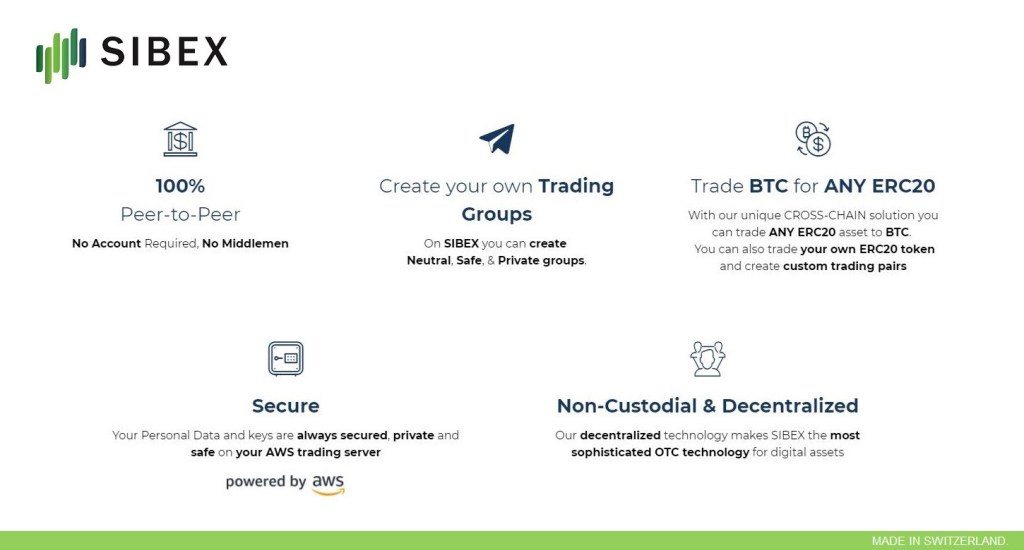
Decentralized: Be your own exchange. Here at SIBEX, we believe in decentralization. Over the years, digital assets worth over hundreds of millions of dollars have been drained from centralized exchanges from major hacks and security breaches. By running your own personal trading server, your personal data and keys are always secured and private.
Not only do centralized exchanges run the risk of being hacked, they also crash during peak times. When a client-server (centralized exchange) system is built, how quickly you can service an increased load on the system (scalability) is an important consideration. The number of users expected to be active at a given time dictates the number of servers that are operated. From the standpoint of centralized exchanges, energy and money is wasted from buying too many servers and having them remain dormant and unused. When the peak load goes beyond what is planned, the centralized service simply stops working. This will not happen on SIBEX. With SIBEX’s decentralized technology, you can trade anytime and anywhere while keeping full control of your assets.
Exchange, Everything. Decentralized. As every SIBEX user operates their own server, scalability is a perfect 1:1 user-to-server ratio. There are no middlemen between your P2P trades, the principal-agent problem has thus been removed entirely.
Connecting to a private trading server is very straightforward — you can read our setup instructions, or follow simple steps from a short walkthrough video.
Users who are new to the SIBEX Platform can set up their own private trading server with just a few clicks. After a short 15-minute wait for the installation process to complete, go to https://otc.sibex.io, connect to your private trading server, and you can start trading on the SIBEX Platform.
Why AWS? AWS meets the highest standards for privacy and data security. Using AWS, you will gain the control and confidence you need to run your trading server with the most secure cloud computing environment available today. All data flowing across the AWS global network is automatically encrypted at the physical layer before it leaves the AWS secured facilities.
Thanks to a close working relationship with AWS Cloud Computing Services, the default recommended approach is to set up a server with AWS. Alternatively, you may also set up your server on any cloud or on your own hardware. If you wish to set up a physical personal server at home, our personal server documentation is here for you.
Despite markets around the world facing economic troubles amid the coronavirus pandemic, it seems that the crypto industry has been able to remain unaffected by COVID-19. Earlier last week, Binance has agreed to buy CoinMarketCap for an undisclosed sum – believed to be one of the largest acquisitions in the blockchain space.
A week has passed since The Block first reported that Binance was in the final stages of acquiring the crypto data site. While some users felt that the acquisition was beneficial for the crypto ecosystem, there are also those who think that the deal could give Binance access to a pool of data and unfair advantage over its competitors.
It did not take long for members of the crypto community to weigh in with their opinions. While CoinGecko’s COO Bobby Ong believes that it will be difficult for CoinMarketCap to stay neutral, according to Cointelegraph, many others are largely supportive of the deal.
CoinMarketCap to Remain Neutral and Independent Fending off concerns over potential conflicts of interest, Binance CEO Changpeng Zhao (CZ) said in an interview with CoinDesk that he had no immediate plans for CoinMarketCap, and that the website will remain independent from Binance under a holding company.
In a recent Ask-Me-Anything (AMA) session, CZ wrote:
My perspective is not to acquire CoinMarketCap so that we can redirect all the traffic to Binance.com. Binance will continue to compete independently. CoinMarketCap will also compete independently. Both platforms need to be able to grow and compete on their own.
On the other hand, CoinMarketCap founder Brandon Chez announced in a letter to their users that he will be stepping down as CEO and will be replaced by the company’s current chief strategy officer, Carylyne Chan, as interim CEO.
Committed to maintaining neutrality and independence, Chen addressed concerns that any cryptoasset or exchange applying for listing on the website will be fairly evaluated in accordance with their listings policy.
I am determined to eliminate any possibility of preferential treatment, and our team has also committed to enforcing this policy. All this will be done in spite of any positive or negative financial effect this adherence to policy might have for our parent company.
Coronavirus update: South Korea confirmed 98 more cases and two additional deaths as of Saturday, while China reported 46 new confirmed cases and six more deaths. Singapore will bar entry and transit to all short-term visitors starting from 11:59 p.m. on Monday. India started a 14-hour curfew as part of the efforts to contain the coronavirus outbreak. Spain’s death toll rose to 1,720.
The death toll from an outbreak of coronavirus in Italy has risen by 651 to 5,476, officials said on Sunday, an increase of 13.5% but down on Saturday’s figure when some 793 people died. The total number of cases in Italy rose to 59,138 from a previous 53,578, an increase of 10.4%, the Civil Protection Agency said — the lowest rise in percentage terms since the contagion came to light on Feb. 21. Of those originally infected nationwide, 7,024 had fully recovered on Sunday compared to 6,072 the day before. There were 3,009 people in intensive care against a previous 2,857.
Pope Francis said on Sunday he will this week deliver an extraordinary “Urbi et Orbi” (to the city and the world) blessing – normally given only at Christmas and Easter – and called for worldwide prayer to respond to the coronavirus crisis.
Markets: The dollar strengthened Friday after a rally that put it on track for its biggest weekly rise since the 2008 financial crisis, as a global scramble for funding sent other currencies reeling. The dollar index rose slightly to 102.82 after weakening 0.7% to 102.00 earlier in the day on Friday.
Gold rose on safe-haven appeal, but was set for a weekly drop. Oil dropped 11% on Friday, giving back early gains, even as the world’s richest nations poured unprecedented aid into the global economy to stop a coronavirus-driven recession. European markets closed higher Friday, following a volatile week as central banks and governments around the world adopted a “whatever it takes” approach.
Crypto Prices (from CoinMarketCap) Bitcoin: Down 5.62% to $5,929.47 Total trading volume (24h): $41.23+ billion USD
Ethereum: Down 7.00% to $125.13 Total trading volume (24h): $12.82+ billion USD
3 biggest movers 24 hours Biggest Mover 1: Electrum Dark (ELD) is up 7,924.96 to $1.04 Biggest Mover 2: WhiteCoin (XWC) is up 252.28% to $0.076751 Biggest Loser: ArdCoin (ARDX) is down 58.70% to $0.000415
What Moved Crypto Markets (i.e. digital assets)
Bitcoin’s correlation with the S&P 500 is at a 2-year high. This is a bearish sign for the cryptocurrency market.
Meanwhile, Bank of China has continued its anti-crypto narrative in a long post titled “3.15 Protection of Financial Consumption Rights and Interests”. The post was published on the bank’s official WeChat account on March 22. In the post, bank officials warn the public about cryptocurrency investment, calling out the three main scams seen on crypto exchanges. The bank stated: “First of all, the amount of fraud transactions with bots is serious. The average turnover rate of the top three overseas cryptocurrency exchanges is much higher than that of foreign licensed exchanges. Second, market manipulation exists in these exchanges where forced leveraged trading eventually causes the exchanges to explode. Third, money laundering is a big issue.”
The Italian Red Cross is now seeking Bitcoin donations to purchase emerging medical equipment after its first-crypto initiative surpassed its goal within three days. On March 12, Italy’s Red Cross launched a BTC fundraising campaign to purchase an advanced medical post for pre-triaging coronavirus cases.
Other Specialties Fintech: Singapore financial-technology firm MatchMovehas teamed up with homegrown finance company Singapura Finance Ltd. and two others to apply for a digital banking license in the city-state. The MatchMove-led consortium is the latest group to announce it’s submitted an application for a digital full banking license to the Monetary Authority of Singapore. That sets the firm against heavyweights including Sea Ltd., which is backed by Tencent Holdings Ltd., and the Grab Holdings Inc.–Singapore Telecommunications Ltd.consortium. Healthtech: Google said on Saturday it launched a United States-focused website with information about coronavirus guidance and testing. The site (google.com/covid19), which consists of resources and links focused on the potentially deadly respiratory illness COVID-19, will be available in more languages and countries in coming days, Google said in a blog post. AI: Researchers have used Artificial Intelligence (AI) to train algorithms and predict tumour sensitivity in three advanced non-small cell lung cancer therapies which can help predict more accurate treatment efficacy at an early stage of the disease. The researchers at Columbia University’s Irving Medical Center analyzed CT images from 92 patients receiving drug agent nivolumab in two trials; 50 patients receiving docetaxel in one trial; and 46 patients receiving gefitinib in one trial. To develop the model, the researchers used the CT images taken at baseline and on first-treatment assessment. “The purpose of this study was to train cutting-edge AI technologies to predict patients” responses to treatment, allowing radiologists to deliver more accurate and reproducible predictions of treatment efficacy at an early stage of the disease,” explained Laurent Dercle, associate research scientist at the Columbia University Irving Medical Center. Smart cities: Lyft Inc on Friday told drivers they could sign up for work driving deliveries under a new service as ride-hailing demand plummets during the rapid spread of coronavirus in the United States. In an email to drivers, Lyft co-founders John Zimmer and Logan Green said, “Those who would like to help neighbors get to grocery stores, workers to hospitals and caretakers to their jobs” can join a new “LyftUp Driver Task Force.” A link sends drivers to a Google doc sign-up sheet. Lyft said the service did not yet exist but will allow drivers to help out with direct on-the-ground needs in their community. Delivery would include medical supplies and test kits and meals for kids and seniors in need that would be picked up from distribution centers and dropped off without contact.
What Moved Global Markets – Coronavirus update: US health officials said on Sunday they had confirmed overall 11 cases, with one in Santa Clara County and two more in San Benito County. WHO Director-General Tedros Adhanom Ghebreyesus warned on Monday that the world may be “dangerously” unprepared for the next pandemic. – Markets reacted: the dollar strengthened and a gauge of global stocks jumped, lifted by an unexpected rebound in U.S. manufacturing that helped temper fears that caused stocks overnight in Asia to plunge on the potential impact of the coronavirus in China. – Some technology firms in China – including Huawei – have maintained operations to manufacture parts and products despite government calls in various cities and provinces for companies to halt work to help stop the spread of a new coronavirus. – Oil falls to a more than 1-year low below $50 on fears the coronavirus will slow global growth. OPEC is reportedly considering large production cut. – The British pound slumped as the European Union and Britain clashed over a post-Brexit trade deal on Monday, with the two sides setting out very different visions of a future relationship that could result in the most distant of ties. Both want to secure a trade agreement, but Britain has set a deadline of the end of the year and the EU has warned that if Prime Minister Boris Johnson wants a no-tariff, no-quota deal, he will have to sign up to its rules to ensure fair competition. Johnson said he would not do that, in a speech that harked back to Britain’s past trading successes, promising that his government would again be a champion of free trade and jealously guard his country’s new-found “sovereignty”.
Crypto Prices (from CoinMarketCap) Bitcoin: Down 1.30% to $9,283.07 Total trading volume (24h): $28.14+ billion USD
Ethereum: Down 0.87% to $189.27 Total trading volume (24h): $11.43+ billion USD
3 biggest movers 24 hours Biggest Mover 1: CloakCoin (CLOAK) is up 198.29% to $0.702132 Biggest Mover 2: Zipper (ZIP) is up 68.32% to $0.000240 Biggest Loser: eosDAC (EOSDAC) is down 81.77% to $0.002472
What moved Crypto Markets (i.e. digital assets) – Bitcoin was up over 29% in January, its best performance for that particular month since 2013. Experts said that bitcoin was being viewed as a “safe-haven asset” as global equity markets remain shaky following the outbreak of the coronavirus. – According to the latest data from Coinbase and Bitbay, Bitcoin usage among merchants is up. Coinbase is also looking to build out its merchant services in 2020. – More than 4,000 bitcoins – an amount worth approximately $37 million as of press time – will be auctioned off by U.S. law enforcement officials on February 18. The U.S. Marshals Service said on Monday that it will put up 4,040.54069820 BTC on the auction block on February 18. A $200,000 deposit is required for those wishing to participate, and would-be bidders must register by February 12. The Marshals Service held its first bitcoin auction in the summer of 2014 – which, as reported at the time, saw investor Tim Draper win nearly 30,000 BTC across 10 auction blocks. A number of other auctions, including more coins seized during the U.S. government’s investigation into the now-defunct dark marketplace Silk Road, have been held in the years since.
Other Specialties Fintech: The day before Brexit, Innovate Finance has put out a report hailing a record 2019 for the UK’s fintech scene and predicting a rosy future. In 2019, the UK smashed its fintech investment record, notching up $4.9 billion of capital raised, surpassing the $3.6 billion the previous year and catapulting the country to second in the global rankings for VC investment.
Fintech firms in the UK attracted more capital and completed more deals than the rest of the top 10 European countries combined. Seven of the top 10 deals in Europe involved UK fintechs, with Greensill leading the way with an $800 million round and OakNorth bagging $440 million. Healthtech: Investment into mental health technology has boomed, reaching £580 million in 2019, according to a study by early-stage investor Octopus Ventures. The research shows an almost five-fold increase in mental health tech investment in the last six years, rising from £120 million in 2014. But the sector still makes up just 15% of overall investment in the digital health market. AI: Elon Musk tweeted he’ll be holding a “super fun AI party/hackathon”… at his house next month. The hackathon seems geared towards bolstering Tesla’s self-driving division. Smart cities: An amusing story of one (big) smart city: how the 2028 Olympics has sparked a transportation revamp in LA.
What Moved Global Markets – Coronavirus: China’s stock market plummets as the country’s death toll climbs past 360. – The first death from the coronavirus outside of China was reported on Sunday and the Beijing government took steps to shore up an economy hit by travel curbs and business shut-downs because of the epidemic. A 44-year-old Chinese man from the city of Wuhan in Hubei province, the epicentre of the epidemic, travelled to the Philippines and died there on Saturday, the Philippines’ Department of Health said. The vice governor of China’s Hubei province, Xiao Juhua, said the virus outbreak was still “severe and complicated”. A total of 304 people have died in China, the National Health Commission said on Sunday. Infections in China jumped to 14,380 as of Saturday, it said. – Apple Inc on Saturday said it would shut all of its official stores and corporate offices in mainland China until Feb 9. as fears over the coronavirus outbreak mounted. The coronavirus is threatening to disrupt large parts of China’s manufacturing machine and its global supply chains as the spread of infection and strict public health measures force companies and workers to remain idle. – BREXIT! It finally happened. The United Kingdom finally cast off from the European Union on Friday for an uncertain future, with Brexiteers claiming victory and popping champagne corks for an “independence day” they said marked a new era for the country.
Crypto Prices (from CoinMarketCap) Bitcoin: Up 1.07% to $9,377.48 Total trading volume (24h): $32.64+ billion USD
Ethereum: Up 5.16% to $190.23 Total trading volume (24h): $14.75+ billion USD
3 biggest movers 24 hours Biggest Mover 1: TCOIN (TCN) is up 524.75% to $0.013344 Biggest Mover 2: WHEN Token (WHEN) is up 71.31% to $0.005894 Biggest Loser: Blocs (BLOCS) is down 26.51% to $55.94
What moved Crypto Markets (i.e. digital assets) – Cryptocurrency investor Arianna Simpson is joining Andreessen Horowitz as a deal partner. The founder and managing director of crypto hedge fund Autonomous Partners announced the news Friday on Twitter. She said she has “admired the brand and platform that a16z has built from afar.” – Hankering for a Ferrari? Well, the only licensed stock exchange in Seychelles islands, is listing tokenized collectible cars worth over $200 million for retail and institutional investors. MERJ said Friday it is partnering with CurioInvest, a tokenization platform building on ethereum, to create tokens representing shares in “supercars” like the Ferrari. While the sale is open to institutional and retail investors, purchases are expected to be driven by institutional investors and those from regions with restrictions on auto imports, such as China. A $1.1 million Ferrari F12tdf will be the first car listed on the exchange, and MERJ said it might list as many as 500 vehicles. – In a recent tweet, Ethereum network co-founder Vitalik Buterin said Bitcoin (BTC) and Bitcoin Cash (BCH) are not the same. “Bitcoin Cash is not Bitcoin,” Buterin said in a Feb 1 tweet responding to Brad Mills’ accusation of Buterin as Bitcoin Cash promoter. Several tweets exist that might suggest Buterin is not 100% against BCH, although he clearly made the distinction that BCH is not BTC, even back in 2017.
Other Specialties Fintech: An amusing survey conducted by Business Insider: how people actually define “fintech”? BI surveyed 21 startups, and their responses varied widely. Beyond Big Tech and Wall Street, startups most would call “fintechs” are scooping up billions in VC funding from traditional venture firms and corporates alike. Some of the people we asked see fintech as an emerging sector, while others pointed out that the ATM, invented in the 1960s, was the first fintech innovation. And some wondered whether big tech firms experimenting with checking accounts and payments products could or should call themselves fintechs. Healthtech: The UAE’s Ministry of Health and Prevention (MoHAP) together with the Ministry of Presidential Affairs, Dubai Healthcare City and other relevant authorities has launched a blockchain-based health data storage platform. According to The Emirates News Agency on Feb. 2, the blockchain-based platform aims to improve the efficiency of the ministry, and will help users streamline the search for health facilities and its licensed medical and technical personnel, as well as to inquire about medicine supply chains. The new data storage blockchain platform will help secure an unchangeable, decentralized and encrypted database with high-security protection to verify data validity and reliability. AI: Artificial intelligence could be throwing off the search for alien life just as much as humans’ own cognitive biases, according to a new paper published in the scientific journal Acta Astronautica. When a neural network was shown an image from a crater on the dwarf planet Ceres, it identified curious patterns, including both a square (which people also saw) and a triangle. After the neural net detected the triangular shape in the images, people in the study also began to see it, even though they hadn’t previously. It’s an example of how false positives from AI could trip up extraterrestrial studies. Smart cities: 100 new airports, 5 new smart cities, 10,000 KM gas grid to be developed in India. To augment India’s infrastructure and create jobs, the government has launched Rs 103 lakh crore worth infra projects besides providing about Rs 1.70 lakh crore for transport infrastructure and accelerating highways construction, Finance Minister Nirmala Sitharaman said on Saturday. Presenting the Union Budget 2020-21 in Parliament, Sitharaman said the focus is on infrastructure for economic development.








 Geoffrey Cheng