
The Rise of DeFi: Adapting to the New World of Digital Assets

A growing number of developers and entrepreneurs are seeking to rebuild and decentralise the financial system using blockchain – databases distributed over many computers around the world and kept secure by cryptography. With huge shoes to fill, can DeFi lay the foundations for a decentralised economy?

Short for decentralised finance, DeFi is an umbrella term for financial services offered on public blockchains like Ethereum. Like traditional financial institutions, DeFi applications allow anyone in the world to borrow, lend, earn interest, and trade derivatives. With the help of smart contracts, agreements can be automatically executed and individuals can transact peer-to-peer without trusting centralised intermediaries such as banks and brokers. The DeFi space has seen exponential growth and it is becoming too big to ignore for governments and financial institutions. According to blockchain research firm Blockdata, a trillion dollars could flood into DeFi if the world’s 100 biggest banks invested as little as 1% of assets under management.

Around the world, regulators begin to turn their attention to cryptocurrencies. Some countries have shown a positive attitude toward crypto, while others wield the crackdown hammer. Earlier in September, El Salvador has become the first country to accept bitcoin as legal tender. In the US, the SEC is reportedly investigating Uniswap Labs, the development firm behind the biggest decentralised crypto exchange. SEC Chairman Gary Gensler also warned that DeFi projects aren’t immune to oversight. On the other side of the world, the People’s Bank of China issued a notice that deemed all crypto transactions to be illegal. However, this isn’t the first time that China has ‘banned’ crypto. Despite the recent ban, traders are able to find alternative ways to invest.

Where does DeFi go from here? Feel free to discuss and share your opinions in the upcoming meeting titled The Rise of DeFi: Adapting to the New World of Digital Assets.

Date: Oct 12th, Tue; 19:00-21:00
Location: Salon 10 (Arbuthnot Rd., 10)
Tickets: HKD30

The meeting will be conducted in groups of 4 people to follow current government regulations for gatherings.

ARTICLES TO READ / VIDEO TO WATCH:
Forkast News
: Institutional DeFi poised to become a $1 trillion industry, Blockdata says – https://forkast.news/institutional-defi-trillion-dollar-industry-blockdata/

The Block: How the SEC’s reported Uniswap Labs investigation could signal a new era of enforcement – https://www.theblockcrypto.com/post/116633/how-the-secs-reported-uniswap-labs-investigation-could-signal-a-new-era-of-enforcement

Cointelegraph: Derivatives DEX dYdX beats out Coinbase’s spot markets by volume amid China FUD – https://cointelegraph.com/news/derivatives-dex-dydx-beats-out-coinbase-by-volume-amid-china-fud

Henri Arslanian Youtube Channel: What is DeFi? – https://www.youtube.com/watch?v=aCYwhWePqh4


FURTHER READING:
Forbes:
 Bitcoin Mining Uses A Higher Mix Of Sustainable Energy Than Any Major Country Or Industry – https://www.forbes.com/sites/greatspeculations/2021/07/06/bitcoin-mining-uses-a-higher-mix-of-sustainable-energy-than-any-major-country-or-industry/?sh=de0633d4cc93

The Economist: Why it is wise to add bitcoin to an investment portfolio – https://www.economist.com/finance-and-economics/2021/09/25/why-it-is-wise-to-add-bitcoin-to-an-investment-portfolio

The Tokenizer: DeFi and tokenization together reshape the financial system – https://thetokenizer.io/2021/03/10/defi-and-tokenization-together-reshape-the-financial-system/

If you decide to join the meeting, please come prepared – read more on the subject, take notes, write down some thoughts and points that you would like to bring for the discussion and share with the group.

We will not have a speaker on the topic, so your self-preparation is key for an intelligent and quality discussion within small groups of 4 people.

Fee: HKD30, it is also suggested that every attendee buys a drink as a courtesy to the venue.

The Economic Club is a community of intellectually curious people in Hong Kong. Learn more about the Economic Club on https://www.econclubhk.org/
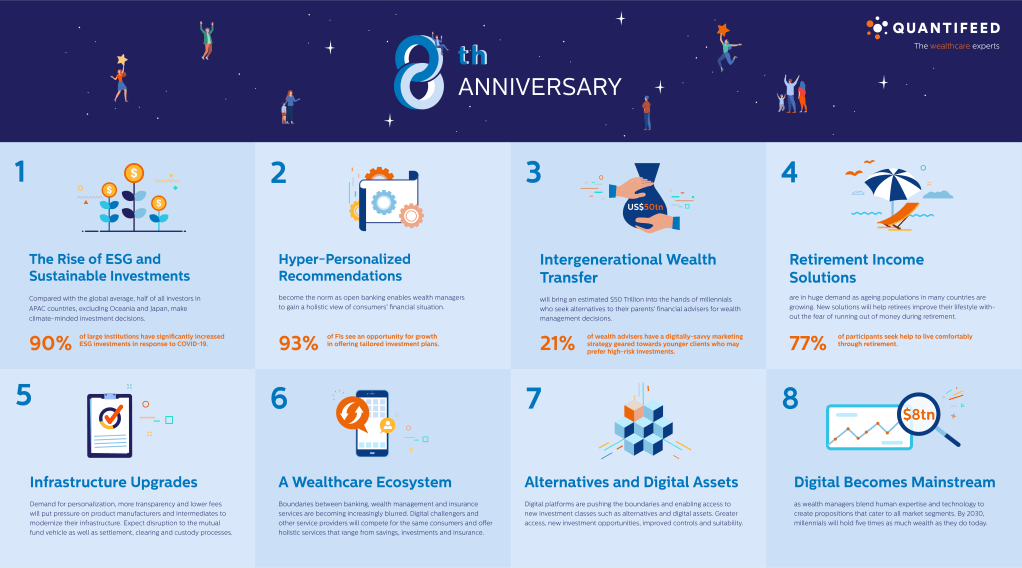

Celebrating Quantifeed’s 8th Anniversary

(Originally published in Quantifeed on June 18, 2021)

It’s Quantifeed’s 8th anniversary! At Quantifeed. we are helping financial institutions provide sustainable, transparent, and affordable wealth management to everyone. As we celebrate our eighth anniversary, we share eight trends that are shaping digital wealth management.

1. The Rise of ESG and Sustainable Investments

  • Compared with the global average, half of all investors in APAC countries, excluding Oceania and Japan, make climate-minded investments decisions.
  • ⁠90% of large institutions⁠ have significantly increased ESG investments in response to COVID-19.

2. Hyper-Personalized Recommendations

  • Hyper-personalized recommendations become the norm as open banking enables wealth managers to gain a holistic view of consumers’ financial situations.
  • 93% of FIs see an opportunity for growth in offering tailored investment plans.

3. Intergenerational Wealth Transfer

  • Intergenerational wealth transfer will bring an estimated $50 Trillion into the hands of millennials who seek alternatives to their parents’ financial advisers for wealth management decisions.
  • 21% of wealth advisers have a digitally-savvy marketing strategy geared towards younger clients who may prefer high-risk investments.

4. Retirement Income Solutions

  • Retirement income solutions are in huge demand as ageing populations in many countries are growing. New solutions will help retirees improve their lifestyle without the fear of running out of money during retirement.
  • 77% of participants seek help to live comfortably through retirement.

5. Infrastructure Upgrades

  • Demand for personalization, more transparency and lower fees will put pressure on product manufacturers and intermediates to modernize their infrastructure. Expect disruption to the mutual fund vehicle as well as settlement, clearing and custody processes.

6. A Wealthcare Ecosystem

  • Boundaries between banking, wealth management and insurance services are becoming increasingly blurred. Digital challengers and other service providers will compete for the same consumers and offer holistic services that range from savings, investments and insurance.

7. Alternatives and Digital Assets

  • Digital platforms are pushing the boundaries and enabling access to new investment classes such as alternatives and digital assets. Greater access, new investment opportunities, improved controls and suitability.

8. Digital Becomes Mainstream

  • Digital becomes mainstream as wealth managers blend human expertise and technology to create propositions that cater to all market segments. By 2030, millennials will hold five times as much wealth as they do today.

The Future is Digital: Scaling DPM for Asian Investors

(Originally published in Quantifeed on May 11, 2021)

Clients across Asia have typically been reluctant to embrace discretionary portfolio management (DPM) services, preferring instead to research, manage and instruct their own investment choices. There are clear signs however that Asian client preferences are beginning to shift. And this shift opens up a number of promising opportunities for financial institutions — it enables them to accelerate digital transformation efforts, and to create new revenue streams. All by building on existing DPM capabilities.

Given the complexity of modern economies, it is increasingly beyond the capabilities of an amateur investor to match the performance of investment professionals. Moreover, while Asian clients have historically been averse to paying for DPM services, growing numbers see the appeal in handing over responsibilities to free up time for other pursuits.

This evolution in client preferences aligns with the interests of private banks and asset management firms. Growing adoption of DPM services means that they can decrease their reliance on ad-hoc, transactional revenues — which ultimately improves resilience during a downturn.

Simultaneously, we are witnessing an enduring switch to digital-first services. Today’s customers demand a rich, immersive, intuitive digital experience from their financial services products — with all the convenience and depth of analysis that implies. Meeting these expectations with clever technology provides service providers with a range of other benefits.

Arguably, the term digital transformation is these days suffering from overuse but it still has some utility in the context of discretionary portfolio management systems. There are inefficiencies, waste and vulnerabilities in the way current DPM processes and infrastructure are set up. Even in an industry as highly digitised as financial services, there is still a high volume of manual processes and data transfer across the systems used by a typical DPM operation. This can involve manual calculation, submission and management of trading orders. Such inefficient order management can lead to excessive trading and high costs.

A lag in recording the processing, execution and settling of transactions means that the business never has a fully accurate and up-to-date view of operations. This in turn results in weak operational controls and a higher risk of compliance breaches.

Thankfully, modern technology can solve many of these issues. Currently, DPM services are restricted to high net-worth individuals, typically with portfolios worth USD 5 million or more. This floor reflects the constraints on the number of clients a DPM team can realistically serve. However, technology tailored for DPM teams supports them by automating trading, monitoring and rebalancing asset allocations at scale. The resulting increase in productivity enables investment experts to manage a larger volume of customers with portfolios well below the usual minimum threshold — meaning that service providers can target new customer segments.

DPM technology integrates with existing systems to provide straight-through processing, eliminate manual errors and provide huge gains in speed and accuracy. It improves the quality of information available to the business, portfolio managers and clients, while reducing the risk of compliance breaches. However, to make this work you need a team that understands the infrastructure, workflows and connections of wealth management systems, and that can provide the right architecture. It’s important that technology shoulders the complexity of the task and not portfolio managers or customers.

For financial services’ retail and mass affluent customers, DPM technology gives them access to high-value wealth management services, typically the reserve of a bank’s wealthiest customers. And it provides them with a digital experience more in keeping with modern tastes — with access to portfolio and performance information at any time, any place on any device and a suite of management and reporting tools.

This value proposition is not just theoretical. Quantifeed is already helping wealth managers — with a wide variety of layers and systems — to scale their DPM operations and offer these services to more customers. In just three months we were able to implement a solution tailored to the needs of a service provider which created new online channels, introduced efficiencies and controls, and improved customer service. Shortly after the launch, the business was managing millions of dollars of assets on behalf of customers they were previously unable to target.

Right now, the growing appetite for discretionary portfolio management services is one of the biggest trends we see across all markets in Asia. Singapore, the private banking hub of Asia, is leading the way with markets such as Japan and Thailand close behind. In Hong Kong, many investors come from China and are also more inclined to trust professionals to run their portfolios.

Change in the delivery of DPM services is coming. And the business case for technology-driven DPM is compelling: it lets a financial institution scale and expand its addressable market. Financial institutions across Asia would do well to get ahead of the coming wave of transformation.

Binance’s Acquisition of CoinMarketCap Prompts Mixed Reactions

Despite markets around the world facing economic troubles amid the coronavirus pandemic, it seems that the crypto industry has been able to remain unaffected by COVID-19. Earlier last week, Binance has agreed to buy CoinMarketCap for an undisclosed sum – believed to be one of the largest acquisitions in the blockchain space.

A week has passed since The Block first reported that Binance was in the final stages of acquiring the crypto data site. While some users felt that the acquisition was beneficial for the crypto ecosystem, there are also those who think that the deal could give Binance access to a pool of data and unfair advantage over its competitors.

It did not take long for members of the crypto community to weigh in with their opinions. While CoinGecko’s COO Bobby Ong believes that it will be difficult for CoinMarketCap to stay neutral, according to Cointelegraph, many others are largely supportive of the deal.

CoinMarketCap to Remain Neutral and Independent
Fending off concerns over potential conflicts of interest, Binance CEO Changpeng Zhao (CZ) said in an interview with CoinDesk that he had no immediate plans for CoinMarketCap, and that the website will remain independent from Binance under a holding company.

In a recent Ask-Me-Anything (AMA) session, CZ wrote:

My perspective is not to acquire CoinMarketCap so that we can redirect all the traffic to Binance.com. Binance will continue to compete independently. CoinMarketCap will also compete independently. Both platforms need to be able to grow and compete on their own.

On the other hand, CoinMarketCap founder Brandon Chez announced in a letter to their users that he will be stepping down as CEO and will be replaced by the company’s current chief strategy officer, Carylyne Chan, as interim CEO.

Committed to maintaining neutrality and independence, Chen addressed concerns that any cryptoasset or exchange applying for listing on the website will be fairly evaluated in accordance with their listings policy.

I am determined to eliminate any possibility of preferential treatment, and our team has also committed to enforcing this policy. All this will be done in spite of any positive or negative financial effect this adherence to policy might have for our parent company.

(Article: Geoffrey Cheng / NexChangeNOW.)